
TIE-AGT-024DocumentedAgent identity/Delegation and authorisation
Multi-hop delegation across agents
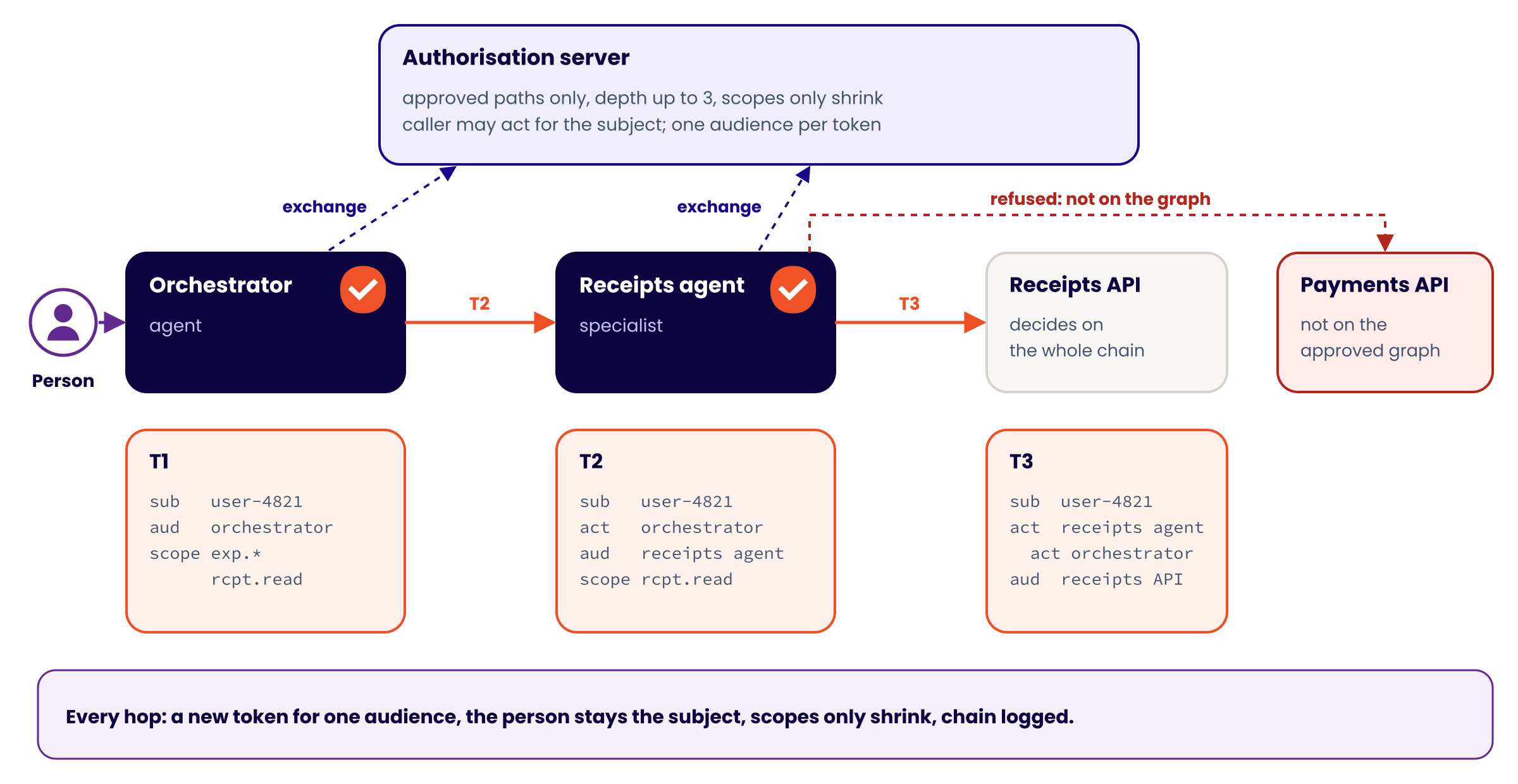
When agents call other agents and tools on a person's behalf, keep the person and every agent in the chain visible to each system, shrink authority at every hop, cap the chain's depth, and never forward a token to an audience it was not issued for.
In short#
- At every hop the calling agent exchanges its token for a new one for the next audience. The new token names the person as subject and the chain of agents as actors.
- Only pre-approved paths are allowed (which agent may call which), scopes can only shrink, and the chain has a maximum depth.
- Each resource decides on the person, every agent in the chain and the requested action, and logs the whole chain.
Problem#
Single agents are giving way to systems of agents: an orchestrator receives a request, plans, and hands parts of the work to specialist agents for research, finance or scheduling, which in turn call tools and sometimes other agents. Each hop is a chance to lose track of who the work is for, or to gain authority along the way.
The common shortcuts are dangerous. Agents forward the original user token to every downstream service, so any service that receives it can replay it elsewhere. Or each agent uses its own broad service credentials, so a specialist agent acts with far more authority than the person had, and the resource cannot tell whose request it is serving. When something goes wrong, nobody can reconstruct which agent asked which to do what.
When to use it#
Use it when
- An orchestrator agent delegates to other agents that call APIs or tools on a person's behalf.
- Agents from different teams, platforms or organisations call each other.
- Resources need to know both the person and the agent that is acting, through several hops.
Avoid it, or add more, when
- A single agent calls tools directly. Single-hop delegation (TIE-AGT-002) is enough.
- Sub-agents are internal functions of one agent in one process with one identity. Treat them as one agent; do not invent identities for code modules.
Forces#
- Traceability against token size. Recording every hop grows tokens and logs.
- Attenuation against flexibility. Strictly shrinking authority can block legitimate plans that need a different tool later.
- Standards against maturity. Token exchange is standard; verifiable chain attenuation is still being drafted.
- Speed against checks. An exchange at every hop adds latency.
Solution#
Treat every agent-to-agent or agent-to-tool call as a new delegation. The caller presents the token it received (the subject token) and its own credentials to the authorisation server and asks for a token for the next audience with the scopes the next step needs. The authorisation server checks that this agent may act for this subject towards that audience, that the path is on the approved graph, that the depth limit is not exceeded and that the requested scopes are a subset of the incoming ones. It issues a token whose subject is still the person and whose act claim nests the chain, newest agent outermost. Resources validate audience and scopes, inspect the chain and apply policy to all of it.
{
  "sub": "user-4821",
  "aud": "https://receipts.api.example.com",
  "scope": "receipts.read",
  "exp": 1795600000,
  "act": {
    "sub": "agt-receipts",
    "act": { "sub": "agt-orchestrator" }
  }
}
Chain rules
| Rule | Enforced at |
|---|---|
| Subject stays the person (or the autonomous agent that started the task) | Authorisation server |
| Each caller may only act for subjects it received tokens for | Authorisation server (may_act or equivalent policy) |
| Only approved caller-to-callee paths | Authorisation server, delegation graph |
| Scopes at each hop are a subset of the incoming scopes | Authorisation server |
| Maximum chain depth (for example 3) | Authorisation server and resources |
| Every token has one audience; no forwarding | Resources reject other audiences |
| Resources decide on the whole chain | Resource or PDP |
| Chain recorded in every log entry | Gateways, resources |
How it works
- Register agents and paths. Every agent has its own identity (TIE-AGT-001). Record which agents may call which other agents and tools: the delegation graph.
- Exchange at each hop. The caller requests a token for the next audience with the incoming token as subject and its own identity as actor.
- Check and narrow. The authorisation server applies the chain rules and issues a token with nested act claims and narrower scopes.
- Authenticate hop by hop. Agent-to-agent protocols such as A2A authenticate each hop at the transport layer; use OAuth tokens from this exchange rather than API keys.
- Decide on the chain. Resources (or their PDP) check the person's rights, each agent's rights and the depth.
- Propagate context inside a domain. Within one trust domain, transaction tokens can carry the immutable subject and actor context through internal services without re-exchanging at every microservice.
- Cross domains deliberately. Between organisations, chain through each domain's authorisation server (identity chaining) instead of trusting foreign tokens directly.
Design rules#
- New token per hop. Never forward a token to another audience.
- The person stays the subject; agents are actors.
- Approved paths only. A delegation graph, not open calling.
- Authority only shrinks.
- Cap the depth.
- Resources see and judge the whole chain.
- Log the chain, not just the last caller.
- Cross organisations through each side's authorisation server.
Anti-patterns#
| Anti-pattern | What goes wrong |
|---|---|
| Forwarding the user's token to every agent and tool | Any recipient can replay it wherever its audience allows |
| Specialist agents use their own broad service credentials | They act with more authority than the person; the person disappears from the record |
| Only the last caller is logged | Investigations cannot reconstruct who asked whom |
| Unlimited agent-to-agent calling | A manipulated agent recruits others to reach new systems |
| Scopes widen downstream | A read request becomes a write at hop three |
| API keys between agents | No subject, no chain, no revocation per person |
Trade-offs#
Benefits
- Every system knows whose request it is serving and which agents touched it.
- Authority cannot grow along the chain.
- Unexpected agent-to-agent paths are refused before they start.
- Complete chains in logs for investigation and audit.
Costs and risks
- A token exchange at each hop, with latency and authorisation server load.
- Maintenance of the delegation graph as agents are added.
- Resources and PDPs that understand nested actor claims.
- Some products do not yet emit nested act claims; you may need custom claims or logs.
Recipes#
How to build this pattern on specific products. Each recipe shows its own maturity and when it was last verified.
Ping Identity recipe
Ping Identity
PingOne or Advanced Identity Cloud token exchange with PingGateway
Written from vendor documentation and design experience; not yet lab-tested by Trevonix. Validate each step in a non-production tenant first.
Token exchange per hop with act claims added by mapping, may_act-based path control and gateway enforcement. Written from Ping documentation and Trevonix single-hop lab work.
Configure (Ping)
- Register each agent as an AI agent identity in PingOne or Advanced Identity Cloud.
- Configure token exchange so each agent can exchange the token it received for a token to the next audience. PingOne does not include the act claim by default; add it with an attribute mapping that uses an advanced expression.
- Model the delegation graph in the may_act data or in your exchange policy so only approved callers can act for a subject towards a given audience.
- Enforce audience and inspect the act chain at PingGateway or in Ping's authorisation engine before forwarding to resources.
Gotchas
- PingGateway's built-in token exchange filter performs impersonation exchanges; for delegation with actor tokens, call the authorisation server's token endpoint from a script or have the agent perform the exchange itself.
Okta recipe
Okta
Okta for AI Agents with agent-to-agent resource connections
Written from vendor documentation and design experience; not yet lab-tested by Trevonix. Validate each step in a non-production tenant first.
Agent-to-agent connections let one registered agent call another as a protected resource, with per-path scopes. Written from Okta documentation; not lab-tested by Trevonix for chains.
Configure (Okta)
- Register each agent in Directory > AI agents with a public key.
- For each approved agent-to-agent path, add an agent-to-agent resource connection on the calling agent, so it can invoke the other agent as a downstream resource protected by a custom authorization server.
- Define custom scopes per downstream agent and grant only the scopes the path needs.
- For agent-to-tool hops, use authorization server or MCP server connections; Okta performs the token exchange per connection.
- Log the chain from Okta's System Log events and your gateway logs, as tokens may not carry nested actor claims.
Microsoft Entra recipe
Microsoft Entra
Microsoft Entra Agent ID with on-behalf-of
Written from vendor documentation and design experience; not yet lab-tested by Trevonix. Validate each step in a non-production tenant first.
New token per hop via on-behalf-of; chain recorded in logs because tokens do not nest actors. Written from Microsoft documentation.
Microsoft Entra agent identities can receive access tokens addressed to them and use the on-behalf-of flow to call downstream APIs, so each hop gets a new token for the next audience. Entra's tokens identify the user and the calling application rather than a nested chain of actors, so record the chain in your own logs (for example with a correlation ID and the caller's agent ID at each hop) and restrict which agents can call which APIs through API permissions and Conditional Access for agents.
Saviynt recipe
Saviynt
Saviynt Agent Access Gateway
Written from vendor documentation and design experience; not yet lab-tested by Trevonix. Validate each step in a non-production tenant first.
Distinguishes direct, on-behalf-of and agent-through-agent calls and enforces tool policies. Written from Saviynt's published material.
Saviynt's Agent Access Gateway can determine whether an agent is acting on its own, on behalf of a person, or through another agent, and apply policies to tool access accordingly. Use it to block calls outside the approved delegation graph.
Transaction Tokens and A2A recipe
Transaction Tokens and A2A
Written from vendor documentation and design experience; not yet lab-tested by Trevonix. Validate each step in a non-production tenant first.
Draft standards for propagating agent context inside a domain, and agent-to-agent transport authentication.
Within one trust domain, OAuth Transaction Tokens (IETF draft) carry immutable subject and agent context through internal service graphs, and a draft extension adds agent context for multi-agent flows. For agent-to-agent communication, the A2A protocol authenticates each hop with the security scheme declared in the remote agent's card.
Verification tests#
| Test | Expected result |
|---|---|
| Orchestrator calls an approved specialist | Exchange succeeds; token has sub = person and act = orchestrator |
| Specialist calls an approved API | Token has nested act with both agents; API permits within the person's rights |
| Specialist calls an agent or API not on the graph | Exchange refused |
| Specialist requests a scope the incoming token did not have | Exchange refused |
| Chain deeper than the limit | Exchange refused |
| Specialist forwards its incoming token to the API | API rejects: wrong audience |
| Log for an API call | Shows the person and every agent in order |
Maturity and verification#
Documented. Trevonix has built single-hop delegated token exchange and gateway enforcement on Ping Identity in lab tenants (November 2026); multi-hop chains as described here are written from standards and vendor documentation and have not yet been lab-tested.
Frequently asked questions#
Is nesting act claims standard?
Yes. RFC 8693 defines the act claim and allows it to nest, so a token can record that one agent acted for another, which acted for the person. Few products expose controls over nesting yet, so test what your authorisation server emits.
How deep should chains be allowed to go?
Three is a practical default: orchestrator, specialist, tool. Deeper chains are hard to reason about and to explain to auditors; require an explicit exception for them.
How does this work with A2A?
A2A defines how agents discover each other and exchange tasks; each hop is authenticated at the transport layer with the scheme the remote agent's card declares. Use OAuth with the exchanged tokens from this pattern as that scheme.
Related patterns and references#
- RFC 8693: OAuth 2.0 Token Exchange
- IETF draft: Transaction Tokens for Agents
- IETF draft: Delegation Chain for OAuth 2.0
- Okta Developer: Set up AI agent token exchange (agent-to-agent connections)
- PingOne: AI agents and token exchange for delegation
- Agentic AI Foundation: Designing secure authorization across A2A and MCP
Cite this pattern
Trevonix (2026). Multi-hop delegation across agents (TIE-AGT-024, version 1.0). Identi Patterns. https://exchange.trevonix.com/patterns/tie-agt-024-multi-hop-delegation-across-agents
Licensed under CC BY 4.0. Credit Trevonix and link to this page when you reuse it.
Patterns are guidance, provided as is and without warranty. Test in a non-production environment and check current vendor documentation before you rely on them. Read the full disclaimer.