
TIE-AGT-023DocumentedAgent identity/Delegation and authorisation
Bounded mandates: delegate to agents within limits the user sets
Let a person give an agent a standing, explicit mandate (what it may do, up to what amount, with whom, until when) that is stored as a grant, enforced on every action outside the agent, visible to the person and revocable at any time.
In short#
- The person sets a mandate: actions allowed, limits per action and in total, counterparties or categories, a time window and a purpose. It is stored as a grant with structured authorisation details, not as text in a prompt.
- Every agent action is checked outside the agent against the mandate and the running total. Inside the mandate it proceeds; outside it, the person is asked (TIE-AGT-022) or the action is refused.
- The person can see and revoke every mandate in one place, and every action records which mandate allowed it.
Problem#
People want agents that get things done without being asked about every step: pay recurring bills, rebook a cancelled train within budget, top up an account when it runs low, order office supplies from approved suppliers. Today the choices are poor. Either the agent receives broad standing access (a full payments scope, a stored card) and the only limits are written in its instructions, or it asks the person to confirm every action, which defeats the purpose.
Limits written in a prompt are suggestions. A prompt injection, a model error or a compromised integration can ignore them. What is missing is a way to record the person's limits as data that systems enforce, and to keep a running total so ten small payments cannot add up to one large one.
When to use it#
Use it when
- Agents act repeatedly for a person within limits the person can state in advance.
- The person will not be present for every action (overnight, scheduled, event-driven).
- You need evidence of what the person authorised for disputes or regulators.
Avoid it, or add more, when
- One-off consequential actions. Ask for confirmation of that action instead (TIE-AGT-022).
- Actions with no meaningful limit you can express as data. If the only limit is "use good judgement", the action needs a human each time.
Forces#
- Autonomy against control. Wider mandates mean fewer interruptions and more exposure.
- Expressiveness against enforceability. People think in goals ("cheapest refundable fare"); systems enforce fields (amount, merchant, date).
- Stateless tokens against running totals. A token can carry limits, but only a stateful service can count what has been spent.
- Clarity against legal precision. The person must understand the mandate; disputes need exact terms.
Solution#
Create mandates through a consent step where the person sees and approves structured terms. Store each mandate as a grant with an ID, its authorization_details (types, actions, limits, counterparties, validity) and the agent it is for. Tokens issued to the agent reference the grant, or carry its details for audience-specific checks. A decision point evaluates every action against the mandate and a counter store that tracks usage; it permits, denies, or permits with an obligation to get the person's confirmation when the action is outside the mandate. The person manages mandates in a dashboard, and revocation takes effect at the next decision.
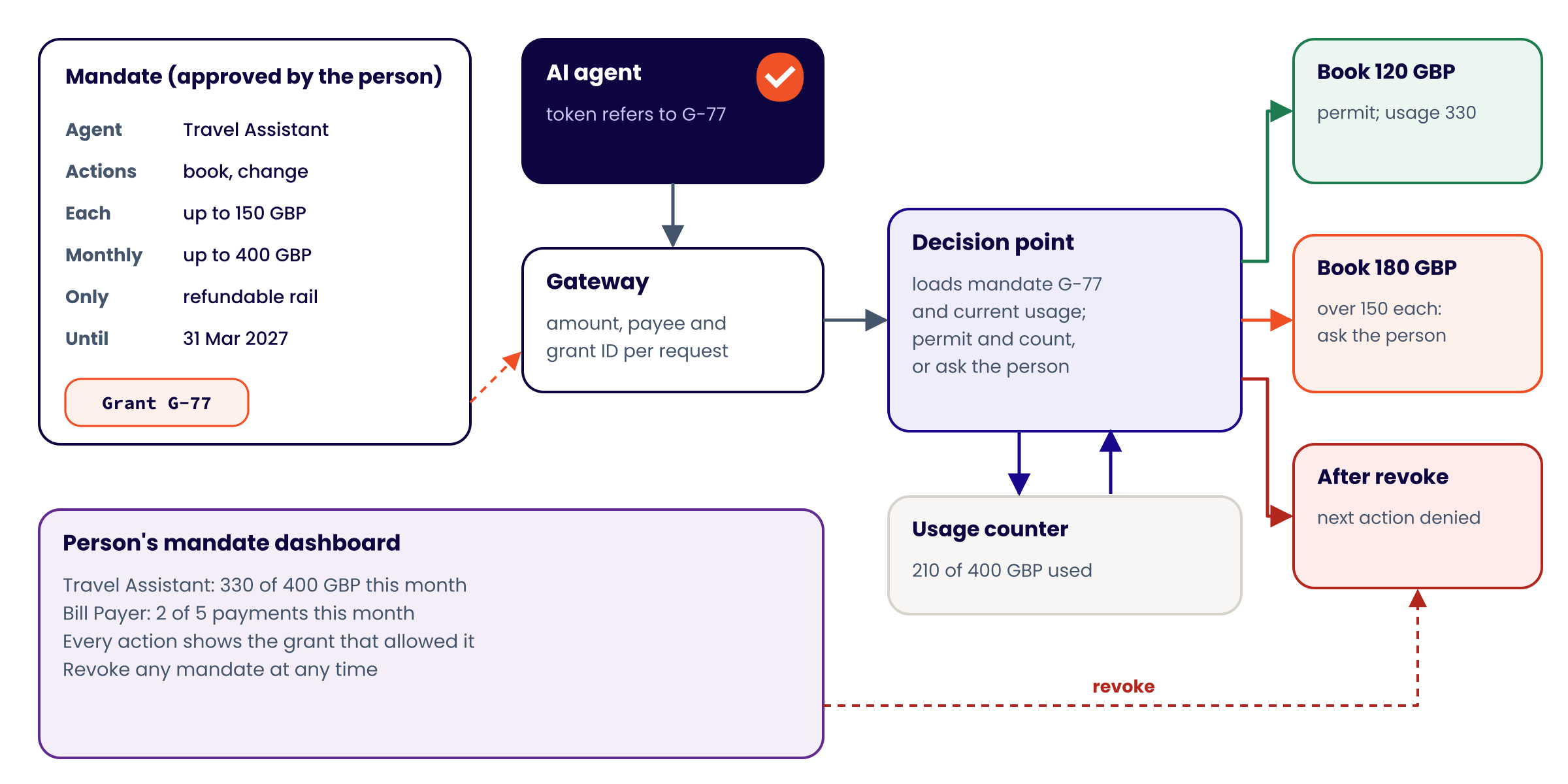
Mandate terms
| Field | Example | Enforced by |
|---|---|---|
| Agent | Travel Assistant (agent ID) | Token issuance and PDP |
| Actions | book, change; not cancel | PDP |
| Per-action limit | 150 GBP | PDP |
| Cumulative limit | 400 GBP per calendar month | PDP with counter store |
| Counterparties or categories | rail operators on an allow-list | PDP |
| Conditions | refundable fares only | PDP, using data from the API request |
| Validity | until 31 March; revocable any time | Grant store and PDP |
| Purpose | business travel for the person | Logged; used in reviews and disputes |
How it works
- Create. The agent proposes a mandate; the person reviews structured terms on a consent screen and approves with strong authentication. The authorisation server stores the grant.
- Issue. Tokens for the agent reference the grant ID (and may carry its authorization_details), with short lifetimes as usual.
- Check every action. The gateway sends the action, amount, counterparty and grant ID to the PDP. The PDP loads the mandate and current usage.
- Decide and count. Within limits: permit and atomically record the usage. Outside: deny, or permit with an obligation to obtain the person's confirmation for this action only.
- Show and revoke. The person sees every mandate, its usage and the actions taken under it, and can revoke it. Revocation is effective at the next decision.
- Expire. Mandates end on their date; renewal is a new consent, not a silent extension.
{
  "type": "travel_booking",
  "actions": ["book", "change"],
  "locations": ["https://booking.api.example.com"],
  "limits": { "per_action": { "currency": "GBP", "amount": "150.00" },
              "per_month": { "currency": "GBP", "amount": "400.00" } },
  "counterparties": ["rail:*"],
  "conditions": { "refundable_only": true },
  "valid_until": "2027-03-31T23:59:59Z"
}Design rules#
- Mandates are data, not prompts. Stored as grants with structured terms.
- Enforced outside the agent, on every action.
- Running totals live in a counter store, updated atomically with the decision.
- Outside the mandate means ask or deny, never "best effort".
- The person sees and controls every mandate. One place to view usage and revoke.
- Every action records its grant ID.
- Mandates expire. Renewal is a fresh consent.
- Narrow beats broad. Several small mandates are safer than one generous one.
Anti-patterns#
| Anti-pattern | What goes wrong |
|---|---|
| Limits only in the system prompt | A prompt injection or model error ignores them |
| Broad payments scope with a stored card | No limit at all except the card's own |
| Per-action limit without a running total | Many small actions add up to a large loss |
| Mandate details only in the token | No running total; no revocation before the token expires |
| Silent renewal | The person forgets the agent still has authority |
| Agent writes the consent text | The person approves the agent's description, not the terms |
Trade-offs#
Benefits
- Agents act without interrupting people for every step.
- Limits that hold even when the agent is manipulated.
- Clear evidence of what was authorised, for disputes and regulators.
- People keep control: visible mandates and instant revocation.
Costs and risks
- A grant store, a counter store and PDP policies that understand mandate types.
- A consent experience and a mandate dashboard.
- APIs that expose amounts and counterparties as structured request data.
- Agreement with legal and risk teams on mandate wording and dispute handling.
Recipes#
How to build this pattern on specific products. Each recipe shows its own maturity and when it was last verified.
Ping Identity recipe
Ping Identity
PingFederate or Advanced Identity Cloud with Ping authorisation and PingGateway
Written from vendor documentation and design experience; not yet lab-tested by Trevonix. Validate each step in a non-production tenant first.
Rich Authorization Requests carry mandate terms; Ping's authorisation engine and a counter service enforce them per action. Written from Ping documentation; not yet built by Trevonix.
Components
| Component | Role in this pattern |
|---|---|
| PingFederate | Supports Rich Authorization Requests in authorization code, client credentials, device and CIBA flows |
| Advanced Identity Cloud | Accepts authorization_details at the authorize and PAR endpoints (partial support added in 2026) |
| PingOne Authorize or PingAuthorize | Evaluates actions against the mandate; a counter service holds usage |
| PingGateway | Extracts amount, counterparty and grant ID from requests and enforces decisions |
Configure
- Define the mandate's authorization_details type and validation on the authorisation server; capture consent with strong authentication.
- Store each approved mandate with a grant ID in a mandate service your PDP can query.
- In PingGateway, extract the action fields and grant ID and call the PDP for each request.
- In the policy, compare the action with the mandate and the counter, permit and increment atomically, or return an obligation to obtain customer confirmation.
Okta recipe
Okta
Okta with an external mandate service
Written from vendor documentation and design experience; not yet lab-tested by Trevonix. Validate each step in a non-production tenant first.
No documented RAR; mandates enforced at the gateway or PDP from your own grant service.
Okta does not document Rich Authorization Requests. Keep the mandate in your own grant service, reference it from the agent's resource connection or a custom claim, and enforce it at your gateway or PDP. Use Okta's CIBA for confirmations outside the mandate.
Microsoft Entra recipe
Microsoft Entra
Microsoft Entra ID with Azure API Management and a mandate service
Written from vendor documentation and design experience; not yet lab-tested by Trevonix. Validate each step in a non-production tenant first.
No RAR; mandates stored and enforced outside Entra.
Microsoft Entra ID does not support Rich Authorization Requests. Store mandates in your application or a mandate service keyed by user and agent identity, and enforce them in Azure API Management or your PDP; use the agent's delegated token for identity and the mandate service for limits.
Saviynt recipe
Saviynt
Saviynt Agent Access Gateway
Written from vendor documentation and design experience; not yet lab-tested by Trevonix. Validate each step in a non-production tenant first.
Runtime intent checks complement amount and counterparty limits held elsewhere.
Saviynt's Agent Access Gateway evaluates agent actions against identity, context, policy and intent at runtime. Use it to block actions outside an agent's declared purpose; keep amount and counterparty limits in a mandate service it can consult.
Auth0 Rich Authorization Requests; AP2 for cross-organisation mandates recipe
Auth0 Rich Authorization Requests; AP2 for cross-organisation mandates
Written from vendor documentation and design experience; not yet lab-tested by Trevonix. Validate each step in a non-production tenant first.
Auth0 RAR for mandate terms in tokens; AP2 for verifiable mandates in agentic commerce.
Auth0 supports Rich Authorization Requests: register the authorization_details types on the API, request them in authorisation or CIBA flows, and read them from the access token at the API. For agentic commerce across organisations, AP2 represents mandates as signed verifiable credentials (intent, cart and payment mandates).
Verification tests#
| Test | Expected result |
|---|---|
| Action within all limits | Permitted; usage recorded with the grant ID |
| Action above the per-action limit | Permit with obligation to confirm, or deny |
| Several actions that together exceed the monthly limit | The one that crosses the limit is held or denied |
| Two concurrent actions near the limit | Only one succeeds (atomic counter) |
| Counterparty not on the allow-list | Denied |
| Person revokes the mandate | Next action denied, even with an unexpired token |
| Mandate expires | Actions denied; agent prompts for a new mandate |
Maturity and verification#
Documented. This pattern is written from standards and vendor documentation, informed by Trevonix's agent delegation and approval lab work (2026). It has not yet been built end to end by Trevonix.
Frequently asked questions#
Why not just use scopes?
They solve different parts. Scopes say which API operations a token may call. A mandate says, within those operations, how much, with whom and until when, and keeps count.
Can the token carry the mandate on its own?
Not entirely. A token can carry the terms so APIs can check per-action limits, but running totals and immediate revocation need a stateful service. Use both.
How does this relate to AP2?
Yes. AP2 represents a person's instructions as signed mandates that merchants and payment networks can verify. Inside one organisation, a grant store and PDP achieve the same control; across organisations, verifiable mandates make the terms portable.
Related patterns and references#
Cite this pattern
Trevonix (2026). Bounded mandates: delegate to agents within limits the user sets (TIE-AGT-023, version 1.0). Identi Patterns. https://exchange.trevonix.com/patterns/tie-agt-023-bounded-mandates-delegate-to-agents-within-limits-the-user-sets
Licensed under CC BY 4.0. Credit Trevonix and link to this page when you reuse it.
Patterns are guidance, provided as is and without warranty. Test in a non-production environment and check current vendor documentation before you rely on them. Read the full disclaimer.