
TIE-AGT-035DocumentedAgent identity/Delegation and authorisation
Agent-to-agent trust across organisations
Let agents from partner organisations call your agents and APIs, and yours call theirs, with the same assurance you expect from federated single sign-on: each side knows which organisation and which agent is calling, for whom, with what authority, and can stop it.
In short#
- Onboard each partner like a federation: agree issuers and keys, which agents, which skills and scopes, which data, for how long, and who answers on each side.
- Verify the partner agent's signed Agent Card, then exchange the partner's assertion for a token from your own authorisation server, narrowed to the agreed scopes. Never accept a partner's access token directly.
- Register partner agents in your inventory with a partner owner, an internal sponsor and an expiry; log with shared transaction IDs; keep a per-partner off switch.
Problem#
Agent protocols make it easy for agents in different organisations to talk. A2A lets an agent discover another through its Agent Card and send it tasks; MCP lets an agent use another organisation's tools. Business wants this: suppliers' agents negotiating with procurement agents, logistics agents updating delivery slots, insurers' agents exchanging claim evidence with repairers'.
Each of those calls crosses a trust boundary. Without a design, teams fall back on shared API keys that never expire, accept the partner's tokens as if they were their own, or trust whatever an Agent Card says about itself. Nobody knows which partner agents are active, what they may do, whether they act for a person or a contract, or how to cut one off when the partner has an incident.
When to use it#
Use it when
- Agents of another organisation call your agents, tools or APIs, or yours call theirs.
- Partners expose A2A agents or MCP servers to you.
- Contracts require you to show which partner did what, and when access ended.
Avoid it, or add more, when
- The partner is a SaaS vendor whose app your people use with their own accounts. Use cross-app access or a token vault (TIE-AGT-007, TIE-AGT-032).
- The other agent is anonymous and public. Treat it as inbound agent traffic (TIE-AGT-034).
Forces#
- Speed of integration against assurance. A shared API key takes an hour; federation takes weeks.
- Partner autonomy against your control. Partners run their own identity providers and agents; you control only what you accept.
- Rich context against data minimisation. Knowing which partner employee is behind a request helps decisions and adds personal data.
- Standards maturity. A2A 1.0 and identity chaining are recent; partner support varies.
Solution#
Treat each partner relationship as a federation with an agreement behind it. Exchange metadata: the partner's authorisation server issuer, the keys that sign its Agent Cards, and the list of agents and skills in scope. At run time, the partner agent fetches your agent's card, and your side verifies the partner's card signature against the agreed keys. The partner agent then obtains an assertion from its own authorisation server addressed to yours (a JWT authorisation grant from identity chaining, or an identity assertion grant), and your authorisation server exchanges it for a short-lived local token with only the agreed scopes, recording the partner, the partner agent and any person or contract reference. Your agents and APIs accept only your own tokens. Partner agents appear in your inventory as external agents with owners and expiry, decisions use partner context, logs carry both sides' transaction IDs, and one switch stops a partner.
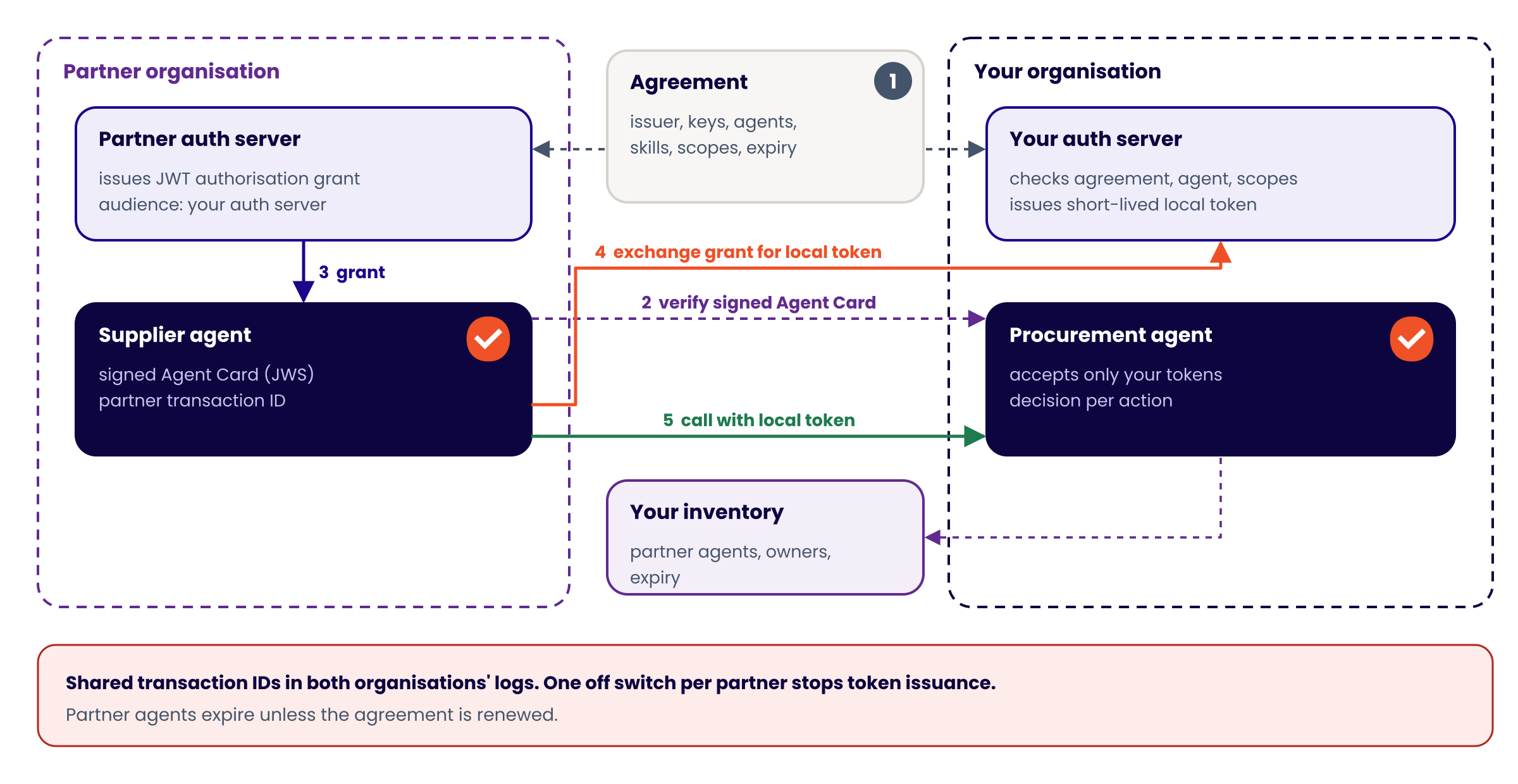
Partner agreement
| Decision | What to agree with the partner |
|---|---|
| Trust anchors | Authorisation server issuer, JWKS location, Agent Card signing keys, key rotation notice |
| Agents and skills | Which partner agents may call which of your agents and skills, and the reverse |
| Scopes and data | Scopes per skill; data classes allowed; retention on each side |
| Acting for whom | Whether calls carry a partner employee, a customer, or only a contract reference |
| Limits | Volumes, values and hours; what needs a human on either side |
| Incidents | Contacts, notification times, how either side stops the other's agents |
| Expiry | End date and review date for each agent in scope |
How it works
- Sign the agreement first: agents, skills, scopes, data, limits, contacts and expiry.
- Exchange and pin metadata: issuer, keys for tokens and for Agent Cards; subscribe to rotation notices.
- Register partner agents in your inventory as external agents with a partner owner, an internal sponsor, risk tier and expiry.
- Verify signed Agent Cards before calling or accepting calls; reject unsigned or unexpected cards.
- Exchange, never accept, partner tokens: your authorisation server takes the partner's assertion (identity chaining or identity assertion grant) and issues a local token with narrowed scopes; mutual TLS or private connectivity adds a second layer for high-value links.
- Authorise per action with partner, agent, skill and contract reference; apply limits and approvals.
- Log with correlation: record the partner's transaction ID alongside yours so investigations can be joined.
- Stop and offboard: a per-partner switch blocks token issuance; agents expire unless renewed.
Design rules#
- No partner agent without an agreement, an owner on each side and an expiry.
- Verify Agent Card signatures against agreed keys.
- Your APIs accept only tokens your authorisation server issued.
- Scopes are narrowed at the boundary to what the agreement allows.
- Partner context is in every decision and every log line.
- One switch stops a partner; expiry stops forgotten ones.
Anti-patterns#
| Anti-pattern | What goes wrong |
|---|---|
| Shared API key per partner | No idea which agent or person used it; it never expires |
| Accepting the partner's access tokens directly | Your APIs trust another organisation's policies and audiences |
| Trusting an Agent Card's contents without a signature | Anyone can publish a card claiming to be the partner's agent |
| Partner agents absent from your inventory | Reviews, kill switches and audits miss them |
| No incident contacts or stop procedure | A compromised partner agent keeps calling until someone finds a person to phone |
Trade-offs#
Benefits
- Cross-organisation automation with the assurance of federated SSO.
- Clear accountability on both sides for each agent and action.
- Fast, contractual revocation of partner access.
- Investigations that can follow an action across organisations.
Costs and risks
- Legal and commercial work for each partner agreement.
- Authorisation server support for cross-domain grants.
- Partners must support signed cards and assertions.
- Ongoing key, agreement and expiry management.
Recipes#
How to build this pattern on specific products. Each recipe shows its own maturity and when it was last verified.
Ping Identity recipe
Ping Identity
Ping token exchange, PingOne Authorize and PingGateway
Written from vendor documentation and design experience; not yet lab-tested by Trevonix. Validate each step in a non-production tenant first.
Local tokens from partner assertions; authorisation at each step of agent chains.
Configure
- Use PingFederate, PingOne or Advanced Identity Cloud token exchange to accept the partner's assertion and issue local tokens with narrowed scopes.
- Use PingOne Authorize to evaluate each step of an A2A chain; Ping's October 2026 Gemini Enterprise Agent Platform integration applies authorisation at each step and passes a verifiable record of the delegation chain downstream.
- Put PingGateway in front of agents exposed to partners for token validation, rate limits and audit.
Okta recipe
Okta
Okta Agent-to-Agent Connections, third-party IdP support and Auth0 Cross App Access
Written from vendor documentation and design experience; not yet lab-tested by Trevonix. Validate each step in a non-production tenant first.
Approved agent-to-agent calls within an org; XAA-enabled external IdPs; Auth0 resource apps accepting enterprise assertions. Written from Okta documentation.
Configure
- For calls between agents inside your organisation, use Agent-to-Agent Connections (GA July 2026): on the called agent's Machine access tab, select a custom authorisation server and audience, then add the calling agent with allowed scopes.
- For partners whose identity providers support Cross App Access, use Okta's third-party IdP support (GA November 2026), so agents authenticated by an XAA-enabled IdP appear in your directory.
- For customer-facing or B2B resource apps on Auth0, Cross App Access support for resource apps (early access, August 2026) accepts identity assertions from enterprise IdPs.
Gotchas
- Agent-to-agent connections in Okta are designed for agents within one org; confirm how a partner's agents will be represented before promising cross-organisation support.
Microsoft Entra recipe
Microsoft Entra
Multitenant agent identity blueprints and Conditional Access
Written from vendor documentation and design experience; not yet lab-tested by Trevonix. Validate each step in a non-production tenant first.
Partner blueprints added to your tenant with consent, controlled by Conditional Access and disabled as a unit.
Configure
- For a partner that builds agents for many customers, ask for a multitenant agent identity blueprint published through Microsoft's catalogues; add it to your tenant and consent only to the permissions in your agreement.
- Apply Conditional Access to the blueprint, which covers every agent identity created from it, and disable the blueprint principal to stop all of that partner's agents at once.
- For partner agents calling your APIs from their own tenant, validate tokens per tenant and restrict accepted tenants and app IDs in your API.
Saviynt recipe
Saviynt
Saviynt inbound and outbound agent access governance
Written from vendor documentation and design experience; not yet lab-tested by Trevonix. Validate each step in a non-production tenant first.
Partner agents registered and governed; only agreed tools published through the gateway.
Saviynt governs both directions of agent access: who may use an agent (inbound, through approval workflows) and what an agent may reach (outbound, mediated by its gateway, where only explicitly published tools are discoverable). Register partner agents with owners and expiry, publish only the agreed tools to them, and review them in access certifications.
A2A signed Agent Cards, identity chaining and SPIFFE federation recipe
A2A signed Agent Cards, identity chaining and SPIFFE federation
Written from vendor documentation and design experience; not yet lab-tested by Trevonix. Validate each step in a non-production tenant first.
Open standards for card authenticity, cross-domain grants and workload trust.
A2A 1.0 Agent Cards carry JWS signatures; verify them before trusting card contents. For workload-level trust between organisations, SPIFFE federation exchanges trust bundles so each side can verify the other's workload identities. The identity chaining specification defines how a token from one domain becomes a JWT authorisation grant accepted by the other domain's authorisation server.
Verification tests#
| Test | Expected result |
|---|---|
| Partner agent presents a card signed with an unknown key | Rejected |
| Partner presents its own access token to your API | Rejected; only locally issued tokens accepted |
| Partner assertion requests a scope outside the agreement | Local token issued without it, or request refused |
| Partner agent past its expiry date | No token issued |
| Per-partner off switch | All of that partner's agents stop within minutes |
| Trace a partner transaction | Both organisations' logs join on the shared transaction ID |
Maturity and verification#
Documented. Written from the A2A 1.0 specification, IETF documents and vendor documentation. Identity chaining across domains has been approved for publication as an RFC; A2A 1.0 with signed Agent Cards was released in March 2026. Product support for cross-domain grants is growing but uneven.
Frequently asked questions#
Is a signed Agent Card enough to authorise a partner agent?
No. Signed Agent Cards prove who published the card. Authorisation still comes from a token your authorisation server issues after checking the partner's assertion against your agreement.
Should partner tokens identify the partner employee?
Where the partner's agent acts for a named person, yes, carry a pseudonymous identifier and keep the mapping with the partner. Where it acts for a contract or process, carry the contract or transaction reference instead.
Related patterns and references#
- A2A Protocol
- Linux Foundation: A2A protocol first-year milestones and version 1.0
- IETF: OAuth Identity and Authorization Chaining Across Domains
- Okta: New AI release highlights (agent-to-agent connections, third-party IdP support)
- Microsoft Learn: Agent identity blueprints (single-tenant and multitenant)
- Ping Identity: Identity for AI what's new
Cite this pattern
Trevonix (2026). Agent-to-agent trust across organisations (TIE-AGT-035, version 1.0). Identi Patterns. https://exchange.trevonix.com/patterns/tie-agt-035-agent-to-agent-trust-across-organisations
Licensed under CC BY 4.0. Credit Trevonix and link to this page when you reuse it.
Patterns are guidance, provided as is and without warranty. Test in a non-production environment and check current vendor documentation before you rely on them. Read the full disclaimer.