
TIE-AGT-034DocumentedAgent identity/Runtime authorisation
Recognise and verify AI agents that visit your website or API
Tell trustworthy AI agents from impersonators and malicious bots, and tell who operates an agent from who authorised it, by verifying signed agent requests at the edge, scoring behaviour, and requiring delegated authorisation from the customer for anything beyond public content.
In short#
- Separate two questions: who operates this agent (verified with signed requests) and who authorised it to act (verified with the customer's delegated token or mandate).
- At the edge, verify HTTP message signatures against the operator's published keys; treat a request that claims a known agent but fails verification as an impostor.
- Write policy by tier: verified agents get public content at agent-friendly limits; account and payment actions need the customer's authorisation; unverified traffic gets bot controls.
Problem#
A growing share of traffic to shops, banks, airlines and content sites comes from AI agents: shopping assistants comparing prices, research agents reading pages, customer agents checking an order or booking a seat. Some of it is welcome and some of it is scraping, credential stuffing or card testing dressed up as an assistant.
The usual signals do not help. User-Agent strings are free to copy. IP ranges are shared by cloud platforms and change often. CAPTCHAs stop helpful agents and are increasingly solved by bad ones. And even when you know which company runs an agent, that says nothing about whether this customer asked it to see their orders or make a purchase. Sites end up either blocking agents they would like to serve, or trusting anything that claims to be one.
When to use it#
Use it when
- Your public website, store or API receives meaningful AI agent traffic.
- You want to serve legitimate agents (search, shopping, customer assistants) better than unknown bots.
- Agents act for your customers on accounts, orders or payments.
Avoid it, or add more, when
- The API is private and every caller is a registered OAuth client. Client authentication already tells you who is calling (TIE-AGT-015).
- The site has no sign-in and no abuse problem. Simple rate limits may be enough.
Forces#
- Openness against abuse. Welcoming agents brings customers; welcoming everything brings fraud.
- Operator identity against user authority. A verified agent company is not the same as an authorised customer.
- Standards maturity against urgency. Signed agent requests are an IETF draft with growing support, not yet universal.
- Edge against application. Signatures are best checked at the edge; customer authorisation lives in the application and identity provider.
Solution#
Verify in layers. At the edge (CDN or WAF), check Web Bot Auth signatures: the agent signs each request with HTTP Message Signatures, includes a Signature-Agent header pointing to its operator's key directory, and you verify the signature, its freshness and the key. Label each request verified, invalid, expired or unsigned, and pass the label and operator to the application. Behavioural detection separates humans, helpful agents and bad bots when no signature is present, and catches impostors. In the application, anything that touches a customer's account requires the customer's own authorisation: a delegated OAuth token issued after the customer signed in and consented, a confirmation on their device (TIE-AGT-022), or a mandate (TIE-AGT-023). Payment networks' agent protocols carry the same two ideas for commerce: a signed agent and a recognised consumer.
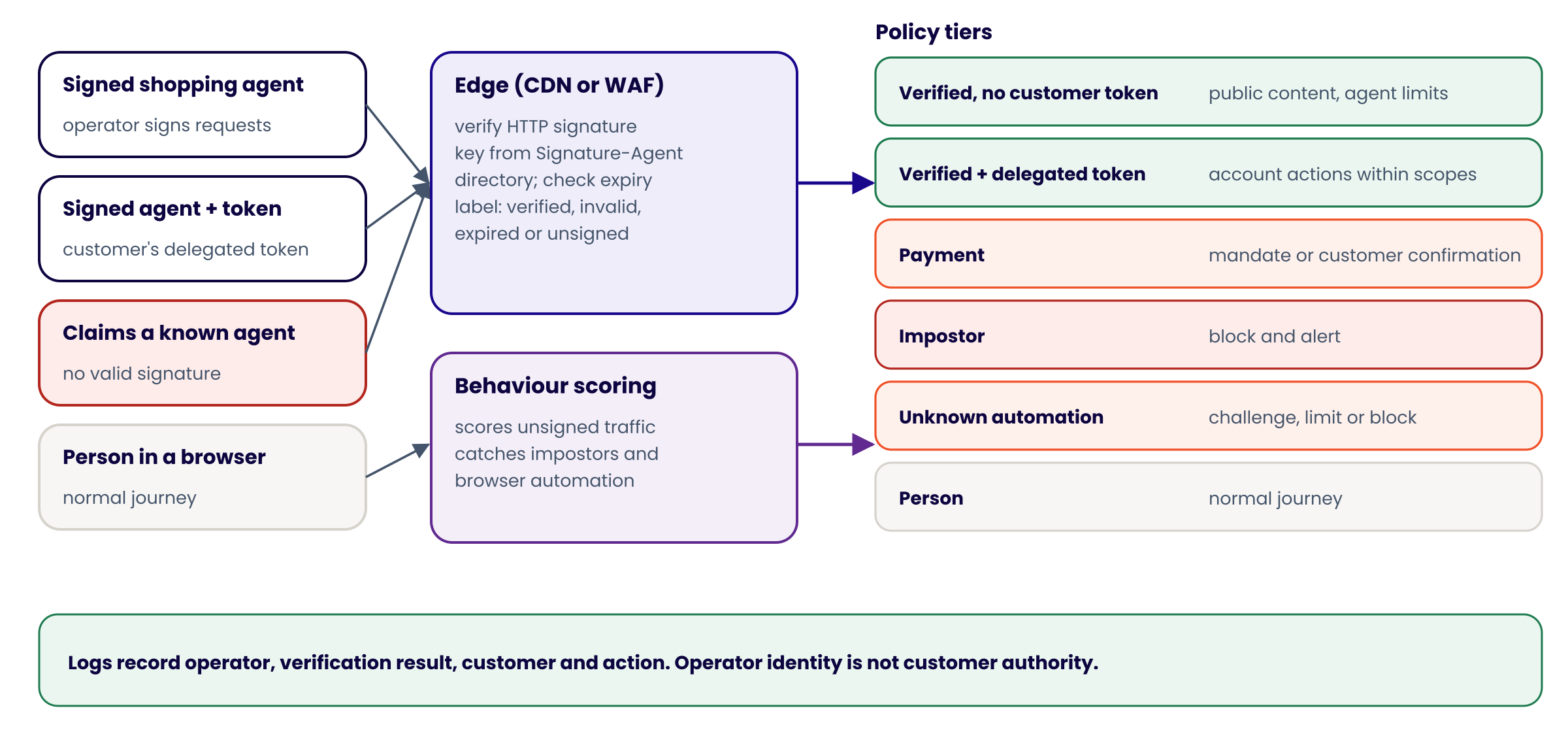
Policy tiers
| Traffic | Verification result | Policy |
|---|---|---|
| Signed agent, no customer token | Operator verified | Public content, agent-friendly rate limits, no account actions |
| Signed agent with customer's delegated token | Operator and customer verified | Account actions within the token's scopes |
| Payment by an agent | Operator verified plus mandate or customer confirmation | Payment within mandate limits or after confirmation |
| Claims a known agent, signature missing or invalid | Impostor | Block and alert |
| Unsigned automation | Unknown | Bot controls: challenge, rate limit or block by risk score |
| Person in a browser | Human | Normal journey |
How it works
- Turn on signature verification at the edge (CDN or WAF) and log results in report-only mode first.
- Decide which operators you trust for which purposes (search, shopping, customer assistants) and record them in an allow-list with owners and review dates.
- Pass verification results to the application in trusted headers set only by the edge, never accepted from the client.
- Add behavioural detection for unsigned traffic and to catch agents driving a browser.
- Require the customer's authorisation for account actions: delegated OAuth with consent for API access, confirmation on the customer's device, or a mandate for repeated purchases.
- Offer agents an API with documented scopes, so they do not need to scrape or drive the UI.
- Monitor verified, impostor and unknown agent volumes; tune limits per operator.
Design rules#
- Operator identity and customer authority are separate checks.
- Signatures are verified at the edge; the application trusts only edge-set labels.
- Claiming to be a known agent without a valid signature is a block-worthy signal.
- Account and payment actions always need the customer's authorisation.
- Trusted operators have owners and review dates.
- Report-only before enforcement.
Anti-patterns#
| Anti-pattern | What goes wrong |
|---|---|
| Allow-listing agents by User-Agent string | Anyone can claim to be a trusted assistant |
| Treating a verified operator as an authorised customer | The agent company's signature unlocks any customer's account |
| Accepting a verification header from the client | Attackers set it themselves |
| Blocking all automation | Helpful agents fail and customers move to competitors |
| Asking agents to share customers' passwords | Credential sharing, account takeover and no consent record |
Trade-offs#
Benefits
- Better service for legitimate agents and their customers.
- Impostors are easy to spot: they claim an identity they cannot prove.
- Clear, auditable rules for what agents may do on customer accounts.
- Less reliance on CAPTCHAs and IP lists.
Costs and risks
- Edge features for signature verification and bot management, often on premium plans.
- An operator allow-list to maintain.
- An API and delegated authorisation flow for agent use cases.
- Standards still in draft; operator adoption varies.
Recipes#
How to build this pattern on specific products. Each recipe shows its own maturity and when it was last verified.
Ping Identity recipe
Ping Identity
PingOne Protect Bot Detection with agent identification
Written from vendor documentation and design experience; not yet lab-tested by Trevonix. Validate each step in a non-production tenant first.
Behaviour and HTTP message signature signals identify computer-using agents and some agent types; branch in DaVinci or journeys.
Configure
- Add the PingOne Signals (Protect) SDK to your web apps (version 5.6.10 or later with isIAFDetectionEnabled and agentIdentification set to true).
- Use PingOne Protect's Bot Detection predictor, which uses browser fingerprint, behaviour, device attributes and HTTP message signatures, and can identify some AI agent types in the risk evaluation response.
- In DaVinci flows (PingOne) or journeys (Advanced Identity Cloud), branch on the result: let verified agents continue to read-only paths, send account actions through delegated authorisation, and mitigate bots.
- Watch volumes in the Agent Detection (CUA) dashboard (early access).
Gotchas
- Bot Detection needs a PingOne Protect licence. Check the exact recommended action values in the risk evaluation API before branching on them.
Okta recipe
Okta
Okta Customer Identity and Auth0 for the customer side
Written from vendor documentation and design experience; not yet lab-tested by Trevonix. Validate each step in a non-production tenant first.
Delegated customer authorisation for agents; signature verification at the edge.
Configure
- Verify agent signatures at your edge provider and pass the result to the application.
- Use Okta Customer Identity or Auth0 for the customer's side: delegated access for agents with consent, CIBA confirmation and Token Vault (Auth0 for AI Agents).
- Okta for AI Agents for Okta Customer Identity (GA November 2026) extends agent identity controls to customer-facing agents.
- Use Auth0 Bot Detection on sign-up and sign-in for unsigned automation.
Gotchas
- Okta and Auth0 documentation reviewed for this pattern does not describe verifying Web Bot Auth signatures; do that at the edge.
Microsoft Entra recipe
Microsoft Entra
Azure Front Door WAF AI bot ruleset and Entra External ID
Written from vendor documentation and design experience; not yet lab-tested by Trevonix. Validate each step in a non-production tenant first.
Group and act on AI bots at the edge (preview); customer authorisation in External ID.
Configure
- On Azure Front Door Premium, enable the AI bot ruleset for Web Application Firewall (public preview, November 2026), which groups AI bots into AI training, AI search, AI interactive agents and miscellaneous AI agents (unverifiable bots, including impostors).
- Set an action per group (Allow, Block, Log, JS challenge or CAPTCHA); every rule starts in Log, so review WAF insights first.
- Use Microsoft Entra External ID for customers' delegated authorisation when agents act on their accounts.
Gotchas
- Microsoft's announcement does not mention Web Bot Auth or how bots are verified; confirm before relying on it for signature-based trust.
Saviynt recipe
Not available
No Saviynt recipe has been published for this pattern yet.
Cloudflare, AWS WAF and payment network agent protocols recipe
Cloudflare, AWS WAF and payment network agent protocols
Written from vendor documentation and design experience; not yet lab-tested by Trevonix. Validate each step in a non-production tenant first.
Edge verification of Web Bot Auth signatures; Visa and Mastercard agent protocols build on it.
Configure
- Cloudflare: Bot Management verifies Web Bot Auth signatures for verified bots and signed agents; on Enterprise plans use the cf.bot_management.signed_agent field in security rules to treat signed agents as a group.
- AWS WAF Bot Control (rule group version 4.0 or later) verifies signatures and adds labels such as web_bot_auth:verified, invalid and expired for rules.
- Payment networks: Visa Trusted Agent Protocol and Mastercard Agent Pay build on Web Bot Auth to identify registered shopping agents and carry consumer recognition to merchants.
Verification tests#
| Test | Expected result |
|---|---|
| Send a correctly signed request from a test agent with a registered key | Labelled verified; agent policy applied |
| Replay a captured signed request after its expiry | Labelled expired; not treated as verified |
| Send a request claiming a known agent with no signature | Treated as impostor; blocked |
| Send a client-supplied "verified" header | Ignored; edge overwrites it |
| Verified agent tries to view a customer's orders without a delegated token | Refused |
| Verified agent with a valid delegated token reads orders | Allowed within scope |
Maturity and verification#
Documented. Written from the IETF draft, edge provider documentation and payment network specifications. Web Bot Auth is a working group draft, and edge support and agent adoption grew through 2025 and 2026; Trevonix has not yet tested it end to end.
Frequently asked questions#
Does a valid signature mean the customer authorised the agent?
No. It tells you which operator sent the request (for example the company running a shopping assistant). It does not say which customer asked for it, or whether that customer authorised the action. Use the customer's delegated token or confirmation for that.
Do we need this for our private APIs?
For machine-to-machine APIs with registered clients, no: OAuth client authentication already identifies the caller. Signed requests matter for open endpoints, websites and agents that are not your registered clients.
Related patterns and references#
Cite this pattern
Trevonix (2026). Recognise and verify AI agents that visit your website or API (TIE-AGT-034, version 1.0). Identi Patterns. https://exchange.trevonix.com/patterns/tie-agt-034-recognise-and-verify-ai-agents-that-visit-your-website-or-api
Licensed under CC BY 4.0. Credit Trevonix and link to this page when you reuse it.
Patterns are guidance, provided as is and without warranty. Test in a non-production environment and check current vendor documentation before you rely on them. Read the full disclaimer.