
TIE-AGT-036DocumentedAgent identity/Governance
Separation of duties for AI agents
Stop agents from completing both sides of a sensitive process, approving their own work, or changing the controls that govern them, by applying separation of duties to agents' entitlements, to agents and the people behind them, to each transaction, and to the control plane.
In short#
- SoD for agents has four layers: entitlements (no toxic combinations on an agent), agent and people (no one approves their own agent's work), transactions (whoever prepared it cannot approve it) and the control plane (agents cannot change their own access, policies, logs or kill switch).
- Treat an orchestrator and its sub-agents, and all agents of one owner, as one actor for SoD purposes.
- Enforce at request time in IGA, at run time in the decision point, and detect violations in scans and reviews.
Problem#
Separation of duties is one of the oldest controls in finance and IT: the person who creates a supplier should not approve its invoices; the developer who writes a change should not deploy it to production unreviewed. Agents break it in new ways.
An agent accumulates entitlements across systems because each one seemed reasonable. A procurement agent can create purchase orders and also approve them below a threshold. A finance agent prepares a payment and the same person who started the agent approves it, so the "four eyes" are one person and their software. Two agents owned by the same team each hold half of a toxic pair, and an orchestrator calls both. An operations agent with admin rights can loosen its own policy or delete the logs that would show what it did. IGA tools usually check SoD for people; agents and the relationships around them fall outside the rules.
When to use it#
Use it when
- Agents take part in finance, procurement, HR, access management or change processes.
- Auditors test separation of duties, and agents now perform steps that people used to.
- Agents hold administrative rights in any system.
Avoid it, or add more, when
- Agents only read data and recommend; people perform every action. Normal SoD for those people applies.
Forces#
- Efficiency against control. End-to-end automation is the point of agents; SoD deliberately breaks the chain.
- Static rules against dynamic behaviour. Entitlement rules miss conflicts that only appear in a specific transaction.
- People and agents. Rules written for individuals do not see the person behind an agent.
- Coverage against noise. Too many rules produce exceptions nobody reviews.
Solution#
Extend your SoD model to agents in four layers. Entitlement SoD: bring agents into your IGA tool as identities and apply the same toxic-combination rules to them, at request time and in scans. Agent and people SoD: an agent's owner, sponsor, the person it acts for, and anyone who requested its access cannot approve its consequential actions or its access; for agents acting on a person's behalf, the person's own SoD constraints apply to the combination of their access and the agent's. Transaction SoD: in the decision point, check history for each action: the identity that created or changed an object, including any agent acting for them and any agent in the same orchestration, cannot approve or release it. Control-plane SoD: agents never hold rights to change their own permissions, policies, approval rules, logs or kill switch, and the team that builds an agent does not approve its production access.
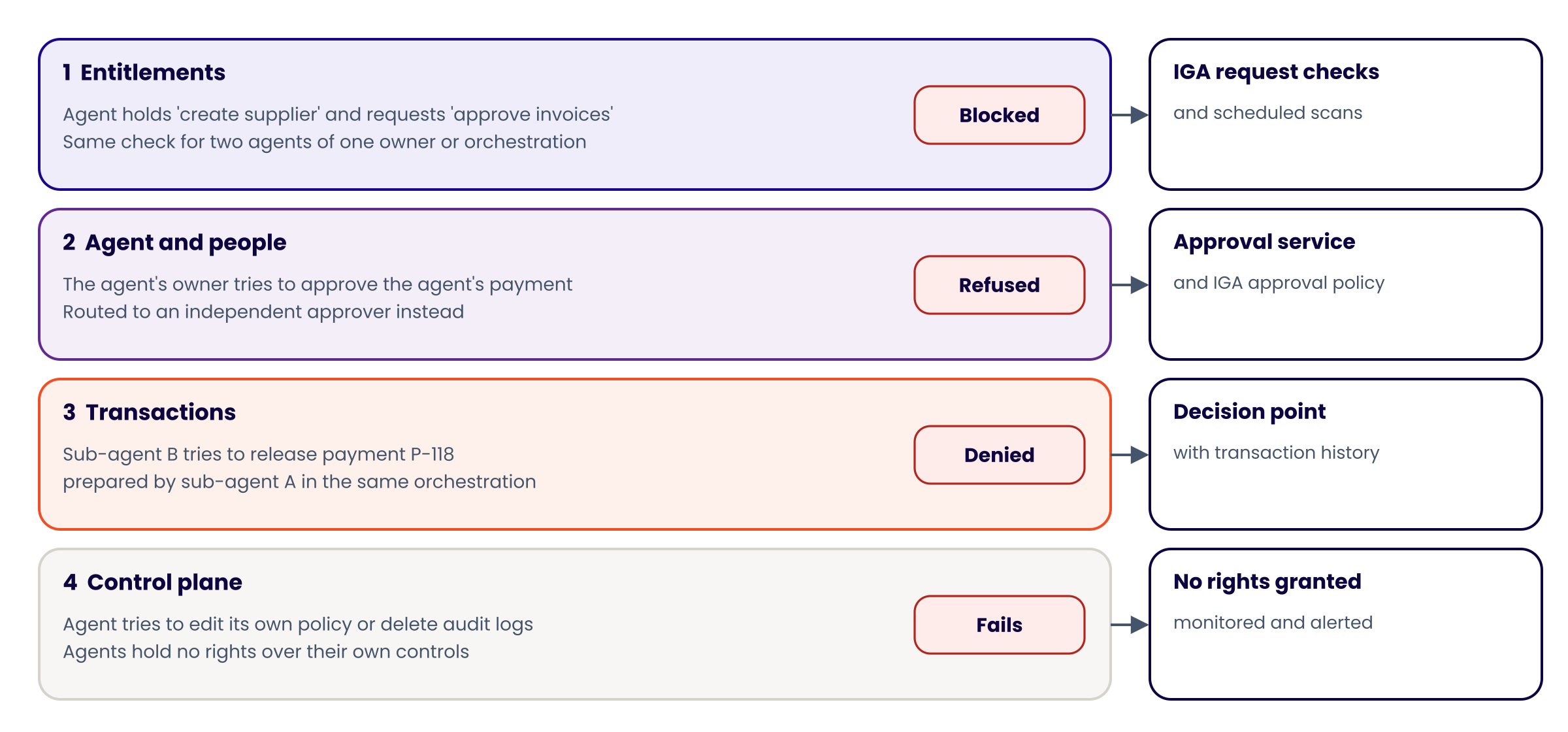
Conflicts and enforcement
| Layer | Conflict | Where enforced |
|---|---|---|
| Entitlements | Agent holds create supplier and approve invoice | IGA request checks and scans |
| Entitlements across agents | Two agents of one owner, called by one orchestrator, hold the two halves | IGA rules on the owner and orchestration group |
| Agent and people | Owner, sponsor or delegator approves the agent's consequential action | Approval service and decision point |
| Agent and people | Person requests access for their agent and approves it | IGA approval policy |
| Transactions | Same actor, or same orchestration, prepares and approves one payment | Decision point with transaction history |
| Control plane | Agent edits its own policy, permissions, logs or kill switch | No such rights granted; monitored |
| Build and run | Team that built the agent approves its production access | IGA approval policy |
How it works
- Inventory sensitive processes that agents touch and write the conflicting step pairs for each (maker and checker, request and approve, create and pay).
- Bring agents into IGA as identities with owners, sponsors and orchestration groupings, so rules can see the relationships.
- Apply entitlement rules to agents and to the owner or orchestration as a group, at request time and in scheduled scans.
- Constrain approvers: exclude the agent's owner, sponsor, delegator and requester from approving its consequential actions or its access.
- Add transaction checks to the decision point using history: preparer, approver, orchestration ID and acting-for person.
- Remove control-plane rights from agents: no write access to their own policies, approval rules, identity, logs or kill switch.
- Review exceptions with expiry and a named risk owner; report SoD violations for agents alongside people.
Design rules#
- Agents are subject to the same SoD rules as people.
- An orchestration, and an owner's agents, count as one actor for SoD.
- No one approves work done by their own agent.
- Preparer and approver are checked per transaction, not only per entitlement.
- Agents never control their own controls.
- Exceptions expire and have a risk owner.
Anti-patterns#
| Anti-pattern | What goes wrong |
|---|---|
| SoD rules that only evaluate human identities | Agents quietly hold toxic combinations |
| Agent owner as default approver for the agent's actions | Self-approval with an extra click |
| Splitting a toxic pair across two agents of the same team | Rules pass; the orchestrator holds both halves |
| Agent with admin rights on the policy engine or log store | It can loosen its own controls or erase evidence |
| Permanent SoD exceptions for automation | The exception becomes the process |
Trade-offs#
Benefits
- Automation without losing a control auditors rely on.
- Fraud and error need collusion between independent parties again.
- Clear evidence that agents are inside the SoD programme.
Costs and risks
- Rule design for agent relationships (owner, orchestration, delegator).
- Decision point changes and transaction history for dynamic checks.
- Some automation needs an independent approver step.
- IGA licensing for agent identities in some products.
Recipes#
How to build this pattern on specific products. Each recipe shows its own maturity and when it was last verified.
Ping Identity recipe
Ping Identity
Ping Identity Governance compliance policies with Agent Governance
Written from vendor documentation and design experience; not yet lab-tested by Trevonix. Validate each step in a non-production tenant first.
SoD policies, scans and violations; agents onboarded as identities. Written from Ping documentation.
Configure
- With the Agent Governance add-on, onboard agents into Identity Governance as identities (the custom_iga_identity_type property set to Agent) with custodians.
- In Governance > Compliance, create policies and policy rules for conflicting entitlements, schedule scans, and handle violations and exceptions.
- Use PingOne Authorize for transaction SoD with preparer and approver attributes.
Gotchas
- Confirm with Ping that your policy rules evaluate identities of the Agent type in your release before relying on scans for agents.
Okta recipe
Okta
Okta Identity Governance SoD rules and agent certifications
Written from vendor documentation and design experience; not yet lab-tested by Trevonix. Validate each step in a non-production tenant first.
SoD rules for user entitlements; certifications for agent resource connections. Written from Okta documentation.
Configure
- Enable Governance Engine for sensitive apps and create separation of duties rules (entitlement or group rules) on each app's Separation of duties tab.
- Configure access request conditions to block or add oversight when a request causes an SoD conflict, and show conflicts to reviewers in certifications.
- For agents, review resource connections with Resource Access Certifications for AI Agents (GA September 2026) and enforce transaction SoD in your decision point.
Gotchas
- Okta's SoD rules are documented for users' entitlements; agents acting on a person's behalf inherit that person's checks, but agents' own resource connections need review and run-time checks.
- Limits apply: 50 entitlements per list, 100 rules per app, 500 rules per org.
Microsoft Entra recipe
Microsoft Entra
Access packages for agent identities with incompatible packages and groups
Written from vendor documentation and design experience; not yet lab-tested by Trevonix. Validate each step in a non-production tenant first.
Request-time SoD for agents in entitlement management. Written from Microsoft documentation.
Configure
- Grant agent access only through access packages for agent identities (Identity Governance), with resource roles limited to security groups, directory roles and API permissions.
- On each sensitive access package, open Separation of duties and add the incompatible access packages and incompatible groups, so an agent holding one cannot request the other.
- Use approval policies with named independent approvers rather than the agent's sponsor.
- Review agent assignments in access reviews and check the Separation of duties report for existing conflicts.
Gotchas
- Agent identities cannot receive application roles, SAP roles or SharePoint site roles through access packages, so existing packages containing those cannot be reused for agents.
- Entitlement management needs Microsoft Entra ID P2 or ID Governance licensing.
Saviynt recipe
Saviynt
Saviynt cross-application SoD with Zuma Governance
Written from vendor documentation and design experience; not yet lab-tested by Trevonix. Validate each step in a non-production tenant first.
Cross-application rulesets applied to agent identities; confirm agent coverage.
Saviynt's cross-application SoD analysis applies rulesets across applications; with agents onboarded as identities with owners in Saviynt (Zuma Governance), include them in the same rulesets and in access reviews. Confirm agent coverage in your release, and add owner and orchestration groupings as attributes rules can use.
Transaction SoD in Cedar, OPA or AuthZEN decision points recipe
Transaction SoD in Cedar, OPA or AuthZEN decision points
Written from vendor documentation and design experience; not yet lab-tested by Trevonix. Validate each step in a non-production tenant first.
Run-time preparer and approver checks using history.
Policy engines such as Cedar or Open Policy Agent, or any AuthZEN-compatible decision point, can express transaction SoD as a rule over request attributes and history: deny release when the approver, or any agent in the same orchestration, prepared the item.
Verification tests#
| Test | Expected result |
|---|---|
| Request an approval entitlement for an agent that holds the matching create entitlement | Blocked or routed as an SoD violation |
| Owner tries to approve their agent's payment | Refused; routed to an independent approver |
| Sub-agent tries to approve a payment prepared by another sub-agent in the same orchestration | Denied by the decision point |
| Agent tries to modify its own policy or delete its logs | Fails; alert raised |
| Scheduled SoD scan with an agent holding a toxic pair | Violation reported with owner |
Maturity and verification#
Documented. Written from established SoD practice and vendor IGA documentation. IGA products are adding agent identities through 2026; whether their SoD rules evaluate agent identities, and owner or orchestration groupings, varies by product and release.
Frequently asked questions#
Is approval by the person who asked the agent to act enough?
No, not where the action needs a second person. The agent is that person's tool, so their approval is not independent; route it to someone with no link to the agent.
Can one agent check another agent's work?
Not for preparation, but the release step should stay with an independent person or a separately governed control. Two agents of the same owner do not make four eyes.
Related patterns and references#
- Microsoft Learn: Access packages for agent identities
- Microsoft Learn: Configure separation of duties checks for an access package
- Okta Help: Separation of duties
- PingOne Advanced Identity Cloud: Segregation of duties
- PingOne Advanced Identity Cloud: Agent Governance
- NIST SP 800-53 Rev. 5 (AC-5 Separation of Duties)
Cite this pattern
Trevonix (2026). Separation of duties for AI agents (TIE-AGT-036, version 1.0). Identi Patterns. https://exchange.trevonix.com/patterns/tie-agt-036-separation-of-duties-for-ai-agents
Licensed under CC BY 4.0. Credit Trevonix and link to this page when you reuse it.
Patterns are guidance, provided as is and without warranty. Test in a non-production environment and check current vendor documentation before you rely on them. Read the full disclaimer.